
Understanding Fluidized-Bed Granulation
Introduction to Fluidized-Bed Granulation
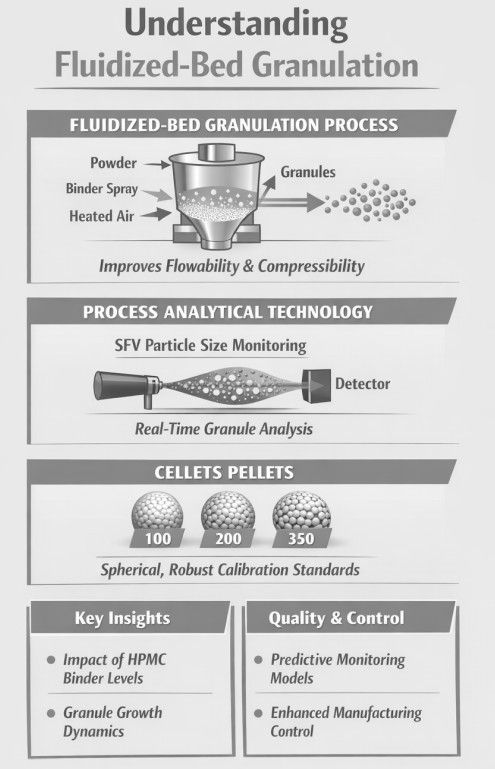
Understanding Fluidized-Bed Granulation starts with its key role in pharmaceutical processing. It improves powder flowability and compressibility for downstream steps. Moreover, the process combines spraying and drying in one system. A binder liquid promotes particle adhesion and forms granules with defined properties. Therefore, manufacturers rely on this method to achieve consistent product quality.
The granule size distribution strongly affects density, flow, and dust formation. Consequently, precise control of granule growth remains essential. In addition, fluidized-bed granulation supports scalable and efficient production. This makes it a preferred technology in modern solid dosage manufacturing.
Technologies and Materials in Fluidized-Bed Granulation
Advanced technologies now enhance Understanding Fluidized-Bed Granulation. Traditionally, operators used off-line methods such as sieve analysis and laser diffraction. However, these methods require sampling and preparation. As a result, they often delay process feedback.
In contrast, in-line tools like spatial-filter velocimetry (SFV) provide continuous monitoring. This technique measures particle size directly in the fluidized bed. Furthermore, SFV uses a laser beam to detect particle chord lengths in real time. This enables fast and reliable tracking of granule growth. Therefore, manufacturers gain deeper insight into process dynamics.
The study uses common pharmaceutical excipients. Dextrose monohydrate and maize starch form the base powder. Hydroxypropyl methylcellulose acts as a binder, while Tween 20 supports wetting. Notably, higher binder concentrations increase granule size and reduce friability. Thus, formulation design plays a major role in final product quality.
CELLETS® appear as reference materials in the study. These spherical pellets provide a stable and low-friability structure. As a result, they help validate particle-size measurement techniques. In particular, they resist breakage during analysis, unlike softer granules. Therefore, they enable accurate comparison between SFV and laser diffraction results.
These MCC spheres had been investigated in this context:
Moreover, CELLETS® offer advantages in broader applications. They ensure uniform coating and predictable drug layering. In addition, their narrow size distribution improves content uniformity. Consequently, they support controlled release formulations and scalable manufacturing. Their robustness and reproducibility make them valuable in fluidized-bed processes.
Conclusion and Outlook
Understanding Fluidized-Bed Granulation shows how process control and analytical tools drive product quality. In particular, SFV enables real-time monitoring of particle-size distribution. Therefore, manufacturers can better understand granule growth and adjust parameters quickly.
Additionally, the study highlights the importance of formulation variables such as binder concentration. These factors directly influence granule size and strength. Meanwhile, CELLETS® demonstrate the value of robust reference particles in analysis and development.
Looking ahead, real-time monitoring will further improve process efficiency. Integration with control systems will allow automated adjustments during production. Consequently, manufacturers can reduce variability and shorten release times. Fluidized-bed granulation will continue to evolve as a key technology in pharmaceutical manufacturing.
Expert’s opinion
From an expert perspective, fluidized-bed granulation combines efficient particle engineering with advanced real-time monitoring. The integration of technologies like SFV significantly improves process understanding and control. Moreover, CELLETS® demonstrate clear value as robust reference materials. Overall, this approach supports consistent product quality and enables future advancements in automated, data-driven pharmaceutical manufacturing.

