CELLETS® in modern pharmaceutical formulations
CELLETS® in modern pharmaceutical formulations play a central role in multiparticulate drug delivery systems. Today, developers demand excipients that do more than fill space. Instead, they expect functional performance, scalability, and regulatory reliability.
As pharmaceutical development advances toward precision dosing and modified release systems, excipients must actively support manufacturability and product performance. Therefore, engineered starter cores have become critical components in capsule, sachet, and sprinkle formulations.
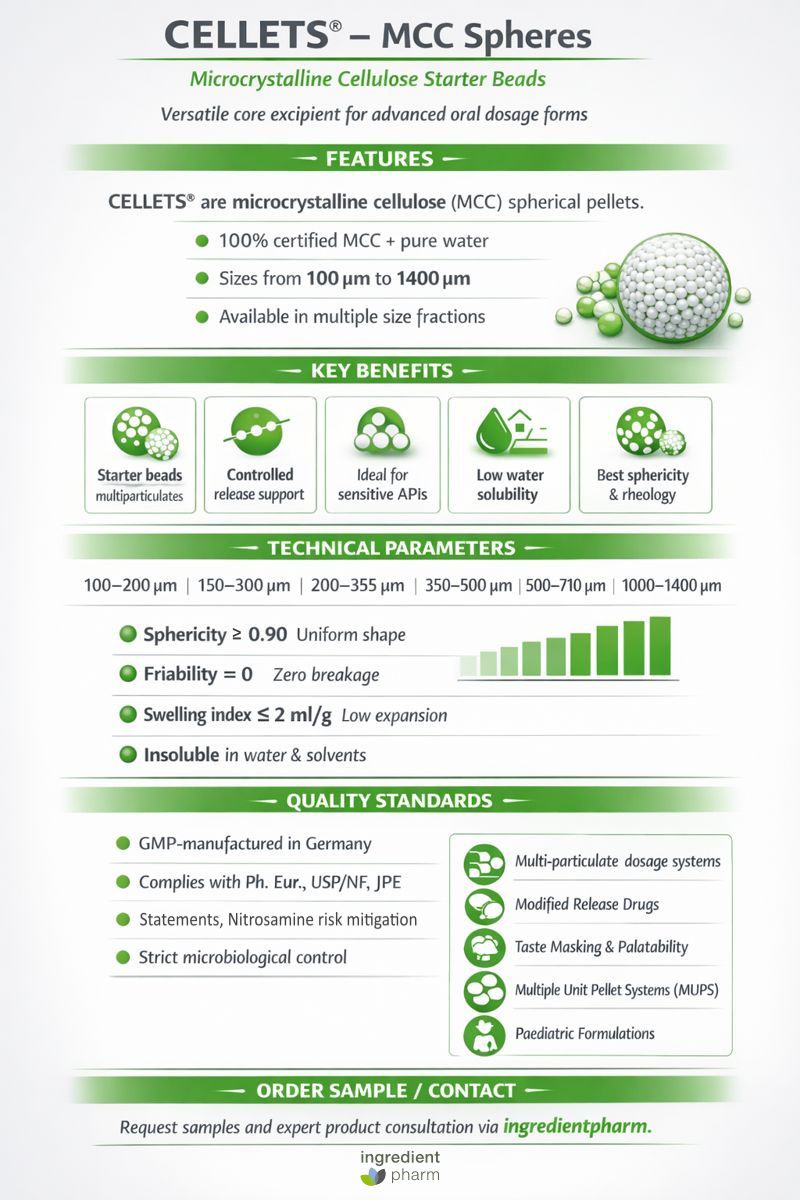
CELLETS® are highly spherical microcrystalline cellulose (MCC) pellets. Manufacturers design them as neutral carrier beads for API layering and functional coating. Consequently, formulation scientists use them to build robust multiparticulate systems with predictable behavior.
What Are CELLETS® as an Excipient?
CELLETS® consist of pharmaceutical-grade MCC pellets produced under GMP conditions. They comply with major pharmacopoeial standards such as Ph. Eur. and USP/NF. Thus, they integrate easily into regulated development programs.
Developers use CELLETS® as starter cores for:
- API layering
- Sustained-release coatings
- Enteric coatings
- Taste-masking systems
- Barrier layers
Unlike irregular granules, CELLETS® provide defined spherical geometry. Moreover, they offer a narrow particle size distribution. As a result, teams achieve higher reproducibility during coating and filling operations.
Why CELLETS® in modern pharmaceutical formulations are preferred
1. Reasons Based on General Features
High Sphericity
CELLETS® exhibit near-perfect roundness. Therefore, coating systems distribute evenly across the surface. In addition, fluid-bed processes run more predictably.
Narrow Particle Size Distribution
The tight size range reduces segregation during transport and capsule filling. Consequently, manufacturers maintain uniform drug content.
Chemically Inert MCC Core
Microcrystalline cellulose remains pharmacologically inactive. Furthermore, it shows broad compatibility with most APIs. This compatibility lowers formulation risk.
High Mechanical Strength
CELLETS® resist abrasion and breakage. As a result, coatings remain intact during processing and handling.
2. Key Benefits for Different Stakeholders
For R&D Teams
First, CELLETS® enable rapid feasibility studies. Moreover, their geometry supports predictable coating trials. Therefore, scientists can optimize release profiles with fewer iterations. In addition, scale-up becomes more straightforward because particle properties remain consistent.
For Quality Experts
Quality teams benefit from strong batch consistency. Furthermore, dissolution profiles remain reproducible. As a result, control strategies align well with ICH Q8, Q9, and Q10 principles. Consequently, regulatory risk decreases.
For Process Technicians
CELLETS® show excellent flowability in hoppers and feeders. In addition, they fluidize uniformly in Wurster systems. Therefore, technicians observe fewer agglomerates and less downtime. Moreover, the low dust tendency improves workplace safety.
For Consumers
Patients benefit from uniform drug release. Additionally, multiparticulates improve swallowability. Therefore, manufacturers can develop pediatric and geriatric-friendly sprinkle formulations.
3. Technical Parameters Supporting CELLETS® in modern pharmaceutical formulations
Controlled Roundness and Aspect Ratio
The near-unity aspect ratio ensures homogeneous coating thickness. Consequently, drug release remains consistent across pellets.
Optimized Surface Morphology
The defined and smooth surface supports lowest API concentrations and destinct coating experiences. Therefore, developers achieve high-potent drug loading with high batch-to-batch reproducibility.
Balanced Density and Flow Properties
CELLETS® provide suitable bulk and tapped density. As a result, capsule filling runs efficiently. Furthermore, fluid-bed expansion remains stable.
Controlled Moisture Content
Manufacturers tightly control residual moisture. Consequently, moisture-sensitive APIs maintain higher stability.
High Crushing Strength
The robust core tolerates multiple coating layers. Therefore, developers can apply drug layers, barrier layers, and functional polymer coatings without structural failure.
4. Size Range Advantages
CELLETS® in modern pharmaceutical formulations are available in a broad size spectrum, typically from about 100 µm up to 1400 µm. Therefore, scientists can select the optimal surface-to-volume ratio and particle sizes for each formulation target.
Smaller Pellet Sizes
Smaller pellets enable faster dissolution when required. Moreover, they improve mouthfeel in sprinkle capsules. Consequently, they suit pediatric applications.
Larger Pellet Sizes
Larger pellets support higher drug loading. In addition, they offer increased mechanical robustness. Therefore, they simplify certain sustained-release designs.
5. Quality and Regulatory Strength
Manufacturers produce CELLETS® under strict GMP standards. Moreover, they ensure compliance with international pharmacopoeias. Therefore, regulatory teams can integrate them into dossiers with confidence.
In addition, suppliers maintain tight specifications for particle size, density, and moisture. As a result, batch-to-batch variability remains low. Consequently, lifecycle management becomes more predictable.
6. Scalability, Processability, and API Layering
CELLETS® perform reliably in bottom-spray, top-spray, and rotor coating systems. Therefore, developers can transfer processes from lab to production scale with minimal adjustment.
Moreover, the spherical geometry enables uniform API layering. As a result, coating weight gain distributes evenly across pellets. In addition, strong adhesion minimizes material loss.
Because the core structure remains stable across scales, process parameters translate reliably. Consequently, manufacturers achieve efficient commercial production with reduced risk.
Conclusion
CELLETS® in modern pharmaceutical formulations provide geometric precision, mechanical stability, and regulatory reliability. Therefore, they support robust multiparticulate design from early development through commercial manufacturing.
R&D teams value their predictability. Quality experts appreciate their consistency. Process technicians rely on their stability. Finally, patients benefit from uniform and reliable drug delivery.
For these reasons, CELLETS® have become a strategic excipient platform in modern pharmaceutical formulation development.
Expert’s opinion
From a formulation science perspective, CELLETS® in modern pharmaceutical formulations offer an exceptionally robust starter core platform. They combine geometric precision, mechanical strength, regulatory reliability, and scalable processability. Consequently, they reduce development risk, simplify quality control, and enable reproducible modified-release systems across laboratory and commercial manufacturing environments.