Scale-Up of Fluidized-Bed Reactors: A Similarity-Based CFD–Machine Learning Framework for Advanced Reactor Design
Introduction
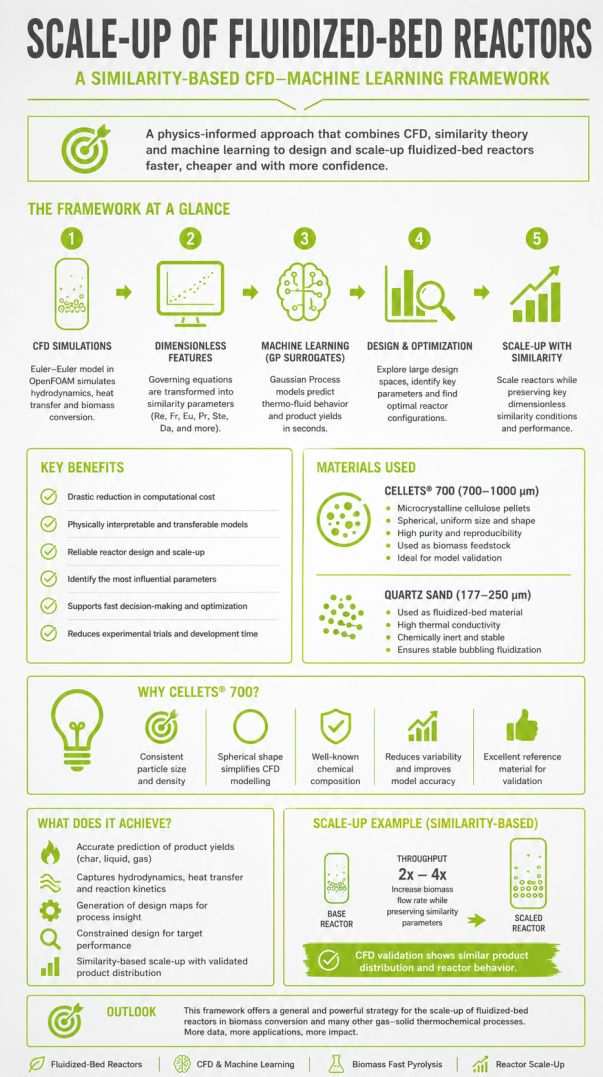
The scale-up of fluidized-bed reactors remains one of the most demanding engineering challenges in thermochemical conversion because successful industrial implementation requires preserving the complex interactions between gas–solid hydrodynamics, heat transfer, and chemical reaction kinetics across different reactor sizes. Conventional design methods frequently rely on empirical correlations or expensive pilot-scale testing, both of which become increasingly inadequate when reactor geometry and operating conditions change significantly. The publication A similarity-based CFD–machine-learning framework for the design and scale-up of fluidized-bed reactors [1] introduces a novel methodology that integrates Computational Fluid Dynamics (CFD), similarity theory, and machine learning into a unified design framework.
Instead of depending solely on computationally intensive CFD simulations or purely data-driven machine-learning models, the proposed approach develops physics-informed surrogate models based on dimensionless similarity parameters. These surrogate models significantly reduce computational effort while maintaining predictive accuracy, making them particularly valuable for reactor optimization and industrial scale-up. The methodology is demonstrated using biomass fast pyrolysis in bubbling fluidized-bed reactors, where standardized CELLETS® 700 microcrystalline cellulose pellets serve as the biomass feedstock for experimental validation and CFD model calibration. Their highly reproducible physical properties provide an ideal reference material, allowing the researchers to isolate hydrodynamic and thermal phenomena from biomass variability while validating the proposed similarity-based design methodology.
Technologies Supporting the Scale-Up of Fluidized-Bed Reactors
Computational Fluid Dynamics as the Foundation
Computational Fluid Dynamics forms the backbone of the proposed framework by providing detailed numerical descriptions of gas–solid flow behaviour inside bubbling fluidized-bed reactors. The simulations employ an Euler–Euler multiphase formulation implemented in OpenFOAM v2506, enabling simultaneous prediction of fluidization dynamics, particle motion, heat transfer, and biomass conversion. Unlike simplified reactor models, the CFD approach captures bubble formation, particle circulation, residence-time distributions, pressure losses, and temperature fields throughout the reactor. These variables strongly influence biomass conversion efficiency and product selectivity during fast pyrolysis. Although CFD delivers highly accurate predictions, each reactive simulation may require several weeks of computation for industrial-scale reactors, making direct optimization impractical. The presented framework therefore uses CFD primarily to generate a comprehensive, high-quality dataset that subsequently trains machine-learning surrogate models capable of providing predictions within seconds instead of weeks.
Machine Learning Accelerates Reactor Design
Machine learning complements CFD by replacing repeated numerical simulations with Gaussian Process surrogate models trained on physically meaningful dimensionless parameters. Rather than using conventional black-box learning algorithms, the authors construct a two-stage surrogate model in which reactor operating conditions first predict thermo-fluid characteristics before estimating pyrolysis product yields. This hierarchical strategy preserves physical interpretability while maintaining excellent predictive accuracy. Automatic Relevance Determination further identifies the most influential design variables, allowing engineers to focus only on the parameters that dominate reactor behaviour during optimization and scale-up. This combination enables rapid exploration of thousands of reactor configurations that would otherwise require an impractical number of CFD simulations.
Similarity Theory Enables Reliable Scale-Up
A major innovation of the study is the incorporation of similarity theory directly into the machine-learning workflow. Instead of relying solely on geometric similarity, the methodology derives a comprehensive set of dimensionless groups describing hydrodynamics, reaction kinetics, heat transfer, particle properties, and reactor geometry. Parameters such as Reynolds, Froude, Euler, Prandtl, Stefan and Damköhler numbers create a scale-independent feature space in which reactor performance can be compared across laboratory, pilot and industrial scales. This physics-informed representation substantially improves the transferability of machine-learning predictions beyond the conditions originally included in the CFD training dataset, overcoming one of the primary limitations of conventional surrogate models.
Materials Used in the Fluidized-Bed Reactor Study
CELLETS® 700 as a Standardized Biomass Feedstock
One of the most significant materials used throughout the investigation is CELLETS® 700, consisting of spherical microcrystalline cellulose pellets with particle diameters between 700 and 1000 µm. These pellets function as the biomass feedstock during fast pyrolysis experiments and serve as the reference material for validating the CFD simulations. The researchers selected CELLETS® because their highly uniform geometry, narrow particle-size distribution, consistent density, and exceptional purity eliminate much of the variability commonly associated with natural biomass. As a result, the observed differences in reactor performance can be attributed primarily to fluidization behaviour, heat transfer and reaction kinetics rather than to inconsistent feedstock characteristics. This reproducibility is particularly important when developing machine-learning models that require highly consistent experimental data for reliable training and validation.
The spherical morphology of CELLETS® 700 also simplifies numerical modelling. Particle diameter, drag behaviour, residence time, and heat transfer coefficients can be represented more accurately than for irregular biomass particles, reducing uncertainty in both experimental measurements and CFD simulations. Consequently, CELLETS® 700 provide an excellent benchmark material for evaluating similarity-based reactor design methodologies.
Quartz Sand as the Fluidized-Bed Medium
While CELLETS® 700 provide the reacting biomass, the fluidized bed itself consists of spherical quartz sand with particle sizes ranging from 177 to 250 µm. Quartz sand serves as the heat carrier, ensuring rapid thermal equilibration of incoming biomass particles while maintaining stable bubbling fluidization. Its excellent thermal conductivity, chemical inertness, mechanical stability and predictable hydrodynamic behaviour make quartz sand an ideal bed material for fast pyrolysis experiments. The combination of quartz sand and standardized cellulose pellets allows the study to isolate thermal and hydrodynamic mechanisms with minimal interference from material variability.
Why CELLETS® 700 Were Selected
The authors deliberately employed CELLETS® 700 because the study focuses on validating a new CFD–machine-learning methodology rather than investigating the influence of heterogeneous biomass feedstocks. Standardized cellulose pellets offer several scientific advantages. Their uniform particle size produces repeatable feeding characteristics, while their spherical shape improves fluidization consistency and facilitates accurate numerical representation within the Euler–Euler CFD framework. Furthermore, the chemical composition of pure microcrystalline cellulose is well understood, allowing the pyrolysis kinetics proposed by Ranzi and co-workers to be validated with minimal uncertainty. These characteristics make CELLETS® 700 an ideal reference biomass for developing transferable reactor design methodologies intended for future application to more complex lignocellulosic materials.
Conclusion and Outlook
The presented CFD–machine-learning framework represents a significant advancement in the scale-up of fluidized-bed reactors by combining first-principles physics, similarity theory and artificial intelligence into a unified reactor design methodology. Rather than replacing Computational Fluid Dynamics, machine learning enhances its practical usefulness by generating fast, interpretable surrogate models capable of exploring extensive design spaces while preserving physical realism. The successful validation using standardized CELLETS® 700 microcrystalline cellulose pellets demonstrates the value of employing highly reproducible biomass materials when developing reliable predictive models for thermochemical conversion.
Their consistent morphology and chemical composition minimize experimental uncertainty and strengthen confidence in both CFD validation and machine-learning training. Although the framework is demonstrated using biomass fast pyrolysis, its underlying methodology is sufficiently general to support future reactor design for gasification, combustion, hydrogen production and other gas–solid thermochemical processes. As additional experimental datasets become available, this similarity-based strategy has the potential to substantially reduce development costs, shorten industrial reactor design cycles and improve confidence in the successful scale-up of fluidized-bed reactors from laboratory research to commercial operation.
References
[1] International Journal of Hydrogen Energy, 255 (2026) 156385; doi: 10.1016/j.ijhydene.2026.156385
Expert’s opinion
This work demonstrates how physics-informed machine learning can transform the scale-up of fluidized-bed reactors. By combining CFD, similarity theory, and standardized CELLETS® 700 pellets for validation, the framework delivers accurate, computationally efficient reactor design while maintaining physical interpretability. It represents a practical step toward faster, more reliable industrial biomass conversion and reactor optimization.