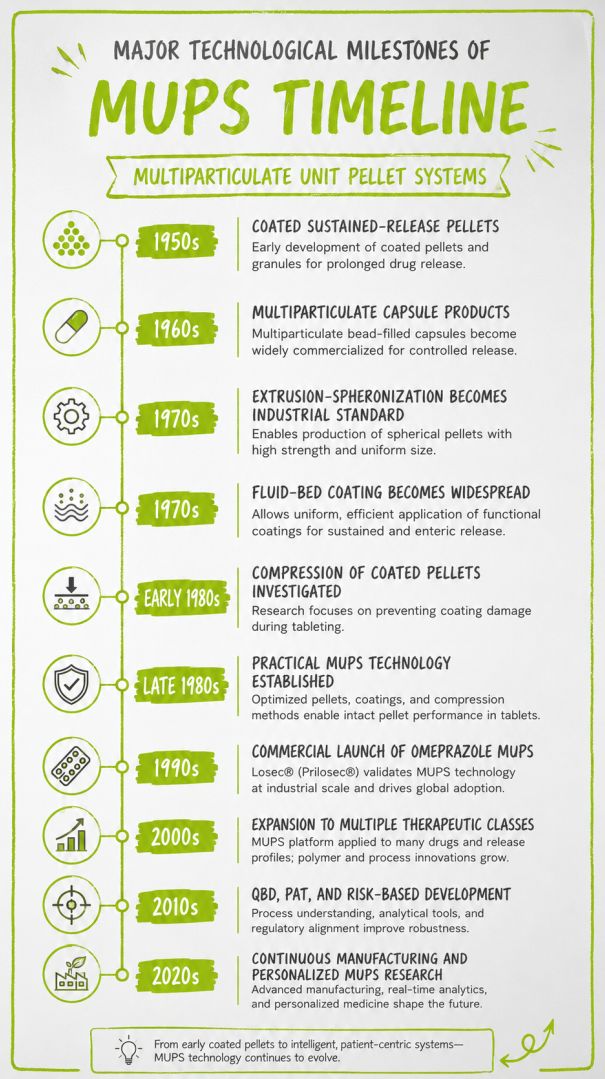
MUPS timeline: A historical scetch of Multiple Unit Pellet System
Historical Timeline of Multiparticulate Unit Pellet Systems (MUPS) in Pharmaceutical Development
Multiparticulate Unit Pellet Systems (MUPS) represent one of the most significant advances in oral modified-release drug delivery. Unlike conventional monolithic tablets, MUPS consist of hundreds to thousands of coated pellets compressed into a tablet or filled into capsules, allowing controlled drug release while maintaining the advantages of multiparticulate dosage forms. Bringing MUPS in a timeline seems to be an exciting and impressive adventure.
The development of MUPS spans more than 70 years, evolving alongside advances in pelletization technology, polymer science, and pharmaceutical manufacturing.
Until the 1950s: Foundations of Multiparticulate Drug Delivery
The earliest sustained-release oral formulations relied on:
- coated sugar spheres
- wax-coated granules
- resin complexes
- coated crystals
These systems demonstrated that dividing the dose into many small units reduced variability in gastrointestinal transit compared with single tablets.
Major developments included:
- sugar-based starter cores
- solvent-based coating technologies
- cellulose derivatives as release modifiers
These products were typically filled into hard gelatin capsules rather than compressed into tablets.
1960s: Emergence of Multiparticulate Capsules
During the 1960s, pharmaceutical scientists recognized several advantages of multiparticulates:
- reduced dose dumping
- more uniform GI distribution
- lower risk of local irritation
- improved reproducibility of drug absorption
Commercial sustained-release capsule technologies became increasingly common, using:
- sugar spheres
- nonpareil seeds
- coated beads
- layered pellets
Coating polymers such as ethylcellulose and cellulose acetate became widely adopted.
1970s: Revolution in Pellet Manufacturing
This decade produced the manufacturing technologies that made modern MUPS possible.
Extrusion–Spheronization
Developed into a reliable industrial process, extrusion–spheronization enabled production of highly spherical pellets with:
- narrow size distribution
- excellent mechanical strength
- high drug loading
- reproducible coating behavior
Microcrystalline cellulose became the standard pelletization excipient.
Fluid-Bed Coating
Fluid-bed coaters allowed:
- uniform polymer coatings
- enteric coatings
- sustained-release membranes
- functional multilayer coatings
This was a major enabling technology for multiparticulate systems.
1980s: Birth of MUPS Technology
Researchers demonstrated that pellets could survive tableting if:
- pellet cores were sufficiently strong
- coatings were sufficiently elastic
- compression forces were carefully controlled
- cushioning excipients protected pellet integrity
This represented the birth of the modern MUPS concept.
Key scientific advances included:
- acrylic polymer coatings
- flexible enteric coatings
- optimized pellet size (typically 0.1–1.5 mm)
- low-friction tableting formulations
1990s: Commercial Breakthrough
The major milestone in MUPS timeline was the introduction of Losec MUPS (known as Prilosec in some markets), developed by AstraZeneca.
The formulation consisted of:
- enteric-coated omeprazole pellets
- compressed into a rapidly disintegrating tablet
- each pellet maintaining its own release characteristics
This solved several practical problems:
- easier swallowing than capsules
- reduced risk of chewing damage
- flexible dosing
- preserved enteric protection
The commercial success of Losec MUPS demonstrated that MUPS could be manufactured at industrial scale while preserving pellet functionality.
2000s: Platform Expansion
Following the success of omeprazole MUPS, the technology expanded to many therapeutic areas.
Applications included:
- proton pump inhibitors
- delayed-release formulations
- sustained-release products
- combination products
Common polymers included:
- methacrylate copolymers
- ethylcellulose
- cellulose acetate
- hypromellose phthalate
- polyvinyl acetate dispersions
Manufacturers increasingly optimized:
- pellet porosity
- coating thickness
- tablet disintegration
- pellet compressibility
2010s: Quality-by-Design and Process Understanding
The pharmaceutical industry adopted Quality by Design (QbD) principles for MUPS development.
Research shifted from empirical formulation toward mechanistic understanding.
Critical Quality Attributes (CQAs) included:
- pellet size distribution
- sphericity
- friability
- coating thickness
- coating uniformity
- tablet hardness
- pellet integrity after compression
- dissolution profile
Critical Process Parameters (CPPs) included:
- extrusion moisture
- spheronization speed
- coating atomization
- inlet air temperature
- compression force
Process Analytical Technology (PAT) and statistical design of experiments became widely used to optimize robustness.
2020s: Milestone in MUPS Timeline – Advanced MUPS
Current research focuses on increasingly sophisticated systems.
Continuous Manufacturing
Instead of batch processing:
- continuous extrusion
- continuous coating
- real-time monitoring
- automated control
are being explored.
Personalized Medicine
Research investigates:
- variable pellet mixtures
- individualized dosing
- pediatric formulations
- geriatric formulations
Novel Pellet Technologies
Emerging approaches include:
- hot-melt extrusion pellets
- lipid-based pellets
- osmotic pellets
- layered pellets with multiple APIs
- amorphous solid dispersion pellets
Digital Manufacturing
Current research explores:
- 3D-printed MUPS tablets
- AI-assisted process optimization
- digital twins
- real-time release testing
Although most remain at the research or early development stage, they illustrate the direction of future innovation.
Overall Evolution
The evolution of MUPS in a timeline can be viewed in four phases:
- Concept (1940s–1960s): Demonstration that multiparticulates improve drug release consistency and gastrointestinal distribution.
- Technology Development (1970s–1980s): Advances in pelletization, coating, and compression science made MUPS technically feasible.
- Commercialization (1990s–2000s): Successful products—most notably omeprazole MUPS—validated the platform and drove broader adoption.
- Optimization (2010s–present): Modern MUPS development emphasizes robust process understanding, regulatory science, advanced manufacturing, and personalized oral drug delivery.
Today, MUPS are considered a mature yet actively evolving platform for oral modified-release formulations, especially where reliable gastrointestinal distribution, protection of acid-sensitive drugs, or flexible release profiles are required.
Expert’s opinion
Multiparticulate Unit Pellet Systems (MUPS) represent one of the most significant advances in oral modified-release drug delivery. Unlike conventional monolithic tablets, MUPS consist of hundreds to thousands of coated pellets compressed into a tablet or filled into capsules, allowing controlled drug release while maintaining the advantages of multiparticulate dosage forms.