Multilayered Pharmaceutically Active Compound-Releasing Microparticles in Effervescent Tablets
Introduction to the Multilayered Pharmaceutically Active Compound Concept
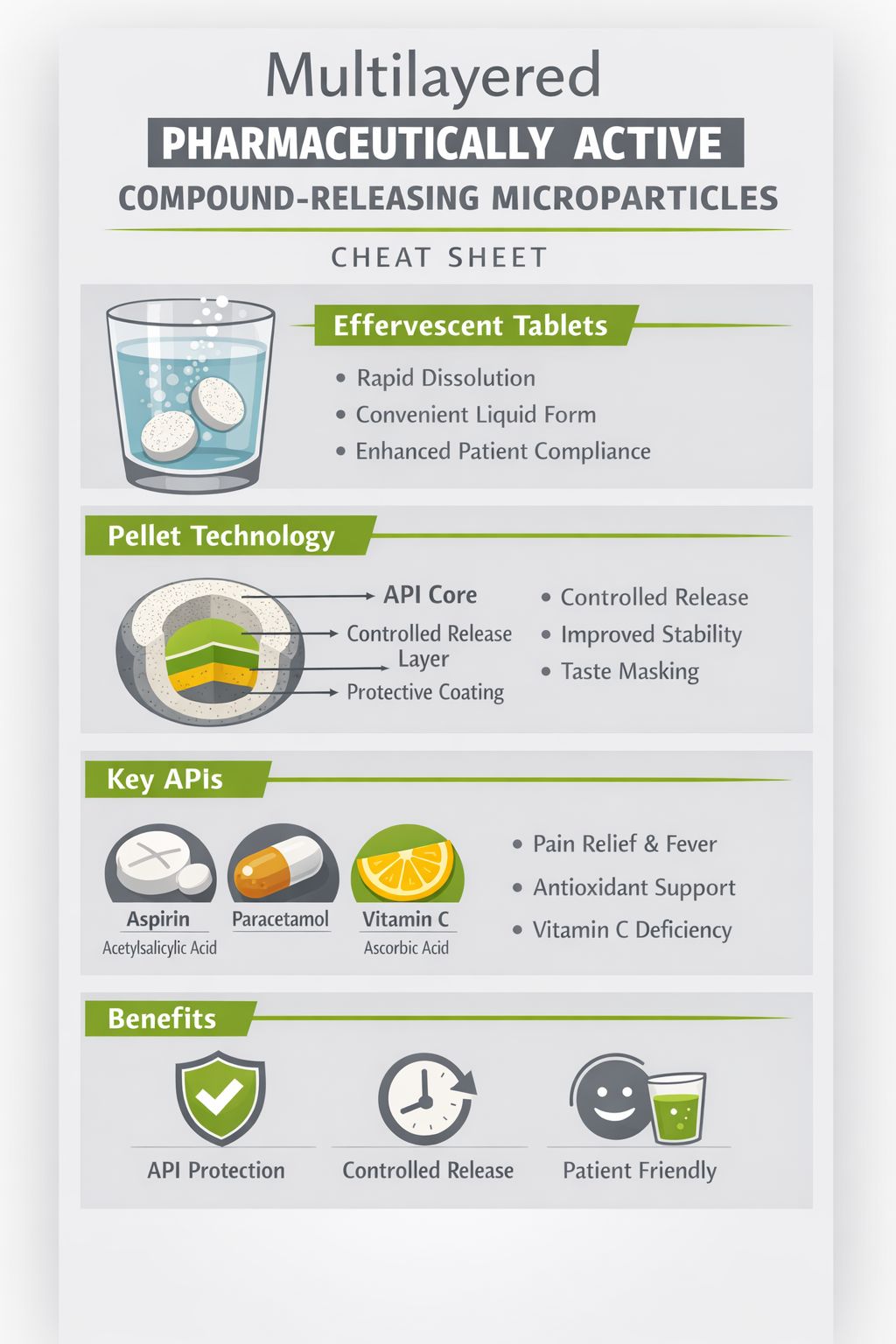
The Multilayered pharmaceutically active compound approach uses coated pellets for controlled, delayed, or site-specific drug release. Effervescent tablets dissolve rapidly in water through an acid-base reaction, producing carbon dioxide and an oral solution. They typically contain citric acid and bicarbonate salts to create a palatable solution before administration. Combining pelletized delivery systems with effervescent tablets offers important pharmaceutical and patient-focused benefits.
Pellets protect sensitive APIs from degradation and separate incompatible ingredients within the formulation. They also improve taste masking, support modified release, and reduce gastrointestinal irritation. Pellet-containing effervescent tablets improve dose uniformity and simplify administration for pediatric and geriatric patients. They also enhance treatment adherence by combining liquid convenience with solid-form stability. These advantages make Multilayered pharmaceutically active compound technology attractive for modern oral drug delivery systems.
Summary of EP3117824A1: Multilayered Pharmaceutically Active Compound-Releasing Microparticles in a Liquid Dosage Form
The patent publication, “Multilayered pharmaceutically active compound-releasing microparticles in a liquid dosage form,” describes an innovative oral drug delivery platform. It addresses stability challenges associated with controlled-release microparticles dispersed in liquid media. The invention uses multilayer microparticles containing a pharmaceutically active compound within a central core. A controlled-release intermediate coating surrounds the core and regulates drug release. An additional outer protective coating further protects the microparticle structure. This coating combines a gastro-soluble hydrophilic polymer with a hydrophobic or insoluble component. Together, these materials form a protective barrier around the controlled-release system. The barrier helps maintain stability during storage in aqueous environments. [Google Patents EP3117824A1]
A key innovation of the patent is the ability to maintain chemical and physical stability of the API while the microparticles remain suspended in a liquid dosage form for extended periods. Traditional enteric-coated particles often lose functionality when stored in aqueous suspensions because the coating can dissolve prematurely. The patented system prevents such degradation and minimizes API leakage into the surrounding liquid, thereby preserving the intended release profile. The inventors report that the formulation can maintain stability for several days or even weeks while limiting premature drug release to very low levels.
The technology is suitable for acid-labile drugs, gastric-irritating compounds, and medications requiring sustained or targeted intestinal release. The microparticles typically use pellet cores made from materials such as microcrystalline cellulose. Drug-containing and functional coating layers are applied using fluid-bed coating and related pharmaceutical processes. After administration, the outer protective layer rapidly dissolves in the stomach. This process restores the original controlled-release properties of the pellet system. The design enables modified-release drug delivery in a convenient liquid dosage form. It is especially beneficial for patients who have difficulty swallowing tablets or capsules. Therapeutic performance is maintained without compromising controlled-release functionality.
The Impact of CELLETS® on this Application
In EP3117824A1, CELLETS® act as inert spherical cores that form the foundation of the multilayer microparticles. Their uniform shape enables precise drug layering and coating, which ensures consistent release behavior and formulation stability. Pellet size is also important: smaller pellets provide a larger surface area and smoother suspension properties, while larger pellets facilitate the application of multiple functional coatings and more complex release profiles. Therefore, CELLETS® play a key role in product performance, stability, and patient acceptance.
API Considerations: Acetylsalicylic Acid, Paracetamol, and Ascorbic Acid
The patent does not specifically focus on acetylsalicylic acid, paracetamol, or ascorbic acid as primary model drugs; however, the described technology is highly relevant to such compounds. Acetylsalicylic Acid is a nonsteroidal anti-inflammatory drug (NSAID) used for pain, fever, inflammation, and cardiovascular protection. It is generally classified as a Biopharmaceutics Classification System (BCS) Class I or Class III drug depending on formulation and ionization conditions. Because aspirin may irritate the gastric mucosa, controlled-release pellet systems can reduce localized stomach exposure and improve tolerability.
Paracetamol is a widely used analgesic and antipyretic agent commonly classified as a BCS Class I drug due to its high solubility and permeability. It is primarily indicated for the treatment of mild-to-moderate pain and fever. Pelletized formulations may enable taste masking, modified release, and improved patient compliance, particularly in pediatric populations.
Ascorbic Acid is a water-soluble vitamin and antioxidant generally categorized as a highly soluble compound. It is used for prevention and treatment of vitamin C deficiency and is frequently included in effervescent formulations. In pellet-containing effervescent tablets, ascorbic acid may benefit from improved stability and compatibility when physically separated from other reactive ingredients.
Conclusion and Outlook
The Multilayered pharmaceutically active compound technology described in EP3117824A1 represents a significant advancement in oral controlled-release drug delivery. By combining multilayer-coated pellets with liquid dosage forms, the invention addresses longstanding challenges related to API stability, controlled release, and patient convenience. The approach is especially promising for incorporation into effervescent tablet systems, where pellet technology can protect sensitive APIs, improve gastrointestinal tolerability, and enhance therapeutic performance. Future developments are likely to expand the application of multilayer microparticles to increasingly complex drug combinations, personalized medicines, and patient-friendly dosage forms that unite the advantages of liquid administration with sophisticated controlled-release functionality.
Patent Summary
- Name of Patent: Multilayered pharmaceutically active compound-releasing microparticles in a liquid dosage form
- Patent Number: EP3117824A1
- Year of Patent: 2015
- Patent Holders: Federica Ronchi, Jonathan Goole, Karim Amighi, Georges Guillaume, Vincent Stephenne
- Affiliation: Be Pharbel Manufacturing
Expert’s opinion
The multilayered pharmaceutically active compound technology represents a significant advancement in oral drug delivery. By combining coated pellet systems (e.g. CELLETS®) with liquid and effervescent dosage forms, it enhances API stability, enables controlled release, and improves patient convenience. Its versatility makes it a promising platform for developing more effective, patient-centric pharmaceutical products in the future.