Jet Milling versus Pelletization: Why Pellet-Based Systems Improve Flow, Reduce Dust, and Ensure Content Uniformity
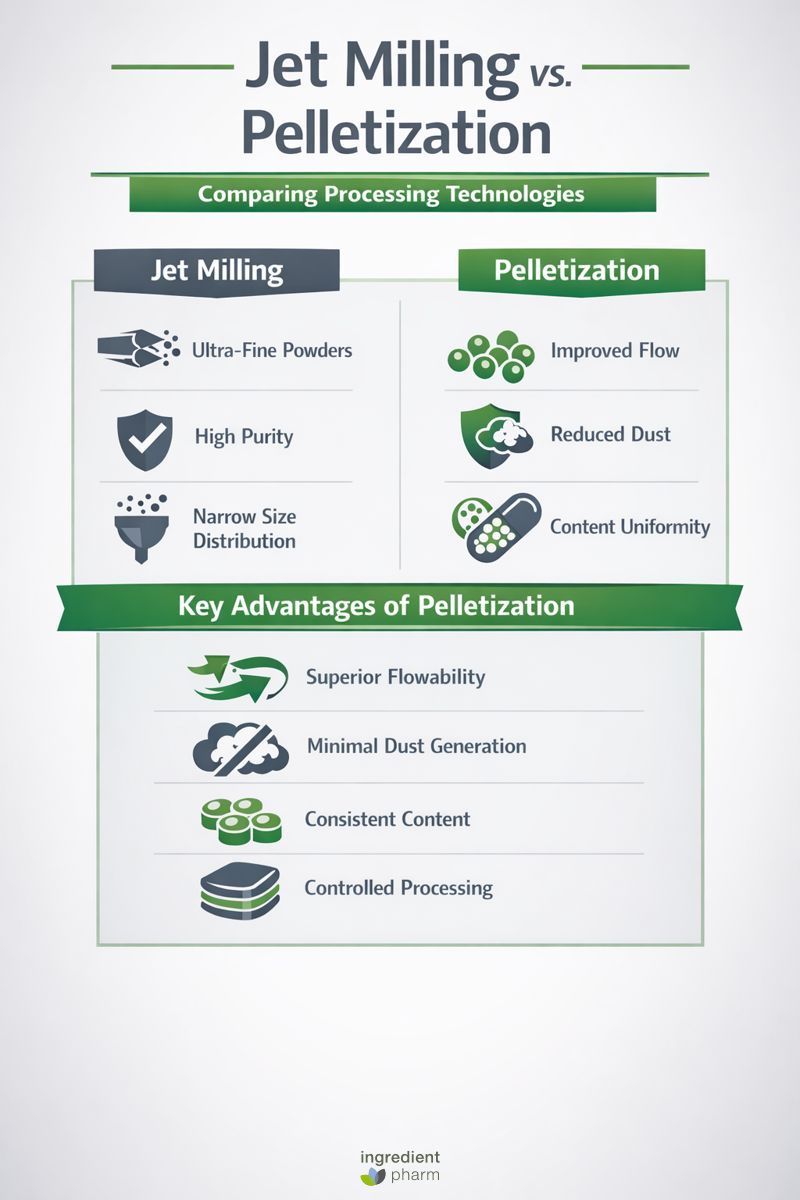
Jet Milling versus Pelletization often arises as a key discussion in particulate processing. Jet milling produces micronized powders through high-velocity gas streams that fracture particles. This method achieves very fine particle sizes and a narrow distribution. Additionally, it avoids contamination from mechanical grinding media. However, fine powders often struggle with cohesion and static charge, which hinders flow. As a result, blending can become uneven, and dust generation can increase, raising safety and contamination concerns.
In contrast, pelletization converts fine powders into larger, controlled pellets using techniques like extrusion, spheronization, layering, or fluidized-bed agglomeration. For example, Glatt’s pelletizing technology creates spherical pellets that are easier to handle. Consequently, pellet-based systems address many of the operational challenges posed by micronized powders.
First, pellets flow more reliably. Their larger, uniform shape reduces friction and cohesion between particles. Therefore, they move smoothly through hoppers, feeders, and other equipment. This advantage proves crucial in automated processes and high-throughput manufacturing.
Second, pelletization reduces dust. Dense pellets release minimal fines into the air, improving workplace safety. Furthermore, reduced dust lowers cleaning demands and minimizes product losses during storage and packaging.
Third, pellets improve content uniformity. Each pellet can contain a precise ratio of active ingredients and excipients. Therefore, dosing becomes more accurate, and blends remain consistent. This benefit is especially important in pharmaceuticals and specialty chemicals.
Additionally, pellets withstand further processing better than micronized powders. They resist abrasion, facilitate coating, and support layered or controlled-release formulations. Moreover, their consistent size ensures predictable performance in tablet compression and capsule filling.
In conclusion, while jet milling excels in producing extremely fine powders, pelletization offers clear advantages in flow, dust reduction, and content uniformity. Manufacturers benefit from easier handling, safer operations, and consistent product quality. Overall, pellet-based systems improve efficiency and reliability across pharmaceuticals, food ingredients, and specialty chemicals.
Expert’s opinion
As an expert, I conclude that while jet milling excels in producing ultra-fine powders, pelletization offers superior operational advantages. Engineered pellets ensure consistent flow, minimal dust, and uniform content, enhancing manufacturing efficiency, dosing accuracy, and safety. For applications where handling and product performance are critical, pellet-based systems provide a more reliable and practical solution than micronized powders.