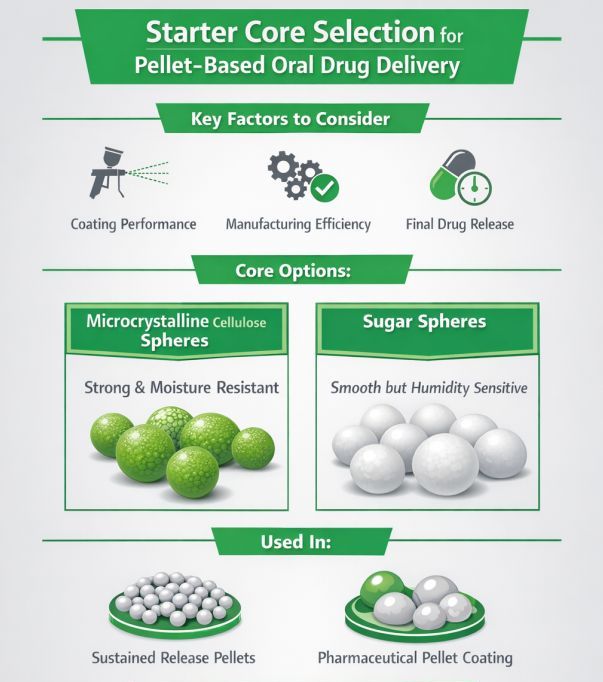
The appropriate starter core selection for pellet-based oral drug delivery
Challenge
- Sugar spheres: Smoothness and enough spherical properties but brittle and water soluble → higher friability, surface chipping, stickiness and deformation during aqueous layering or high humidity; problematic for long processes and moisture sensitive APIs.
- MCC spheres (MCC Spheres): mechanically robust and water insoluble but slightly textured → tradeoffs between surface smoothness and adhesion; need to align with coating strategies and release goals.
Solution
- Select cores based on formulation and process demands.
- MCC spheres for robust mechanical resistance, low friability, moisture stability, long aqueous processing, MUPS compression, and modified/sustained release systems.
- Sugar spheres when layering process are not affected by prolonged aqueous exposure or high humidity.
- Process optimization: adjust spray rate, solvent composition, inlet/outlet temperatures, and humidity control; exploit MCC spheres’ higher adhesion for stronger drug layering when needed.
Proof
- MCC Spheres deform plastically and resist abrasion, producing fewer fines and protecting coating integrity during fluid bed coating and compression.
- Sugar spheres’ crystalline sucrose composition dissolves or softens in aqueous systems, increasing stickiness, surface migration, and friability. These effects are amplified at larger sphere sizes and under high humidity.
- Surface morphology data show MCC Spheres have high sphericity and improved coating robustness versus traditional sugar cores and therefore support better scale up and stability for moisture sensitive or complex modified release formulations.
Takeaway message
- A poor starter core selection can lead to coating failure, content variability, and scale up issues.
- Core selection is a strategic, data driven decision affecting manufacturability, coating performance, dose uniformity and long-term product stability.
- MCC Spheres for robust, moisture stable, and scalable pellet formulations
- Sugar spheres only when process/humidity constraints can be tightly controlled.
- Align the core with API characteristics, process parameters, and target release profile to ensure optimal product performance.
Expert’s opinion
As an expert, I’d emphasize that starter core selection critically influences coating performance, manufacturability, and final drug release. Microcrystalline cellulose spheres offer robust mechanical strength, low friability, and moisture resistance, ideal for complex or sustained-release pellets, whereas sugar spheres suit exceptionally smooth, thin coatings if humidity and process conditions are tightly controlled.