
Clinical Spectrum of Cannabidiol
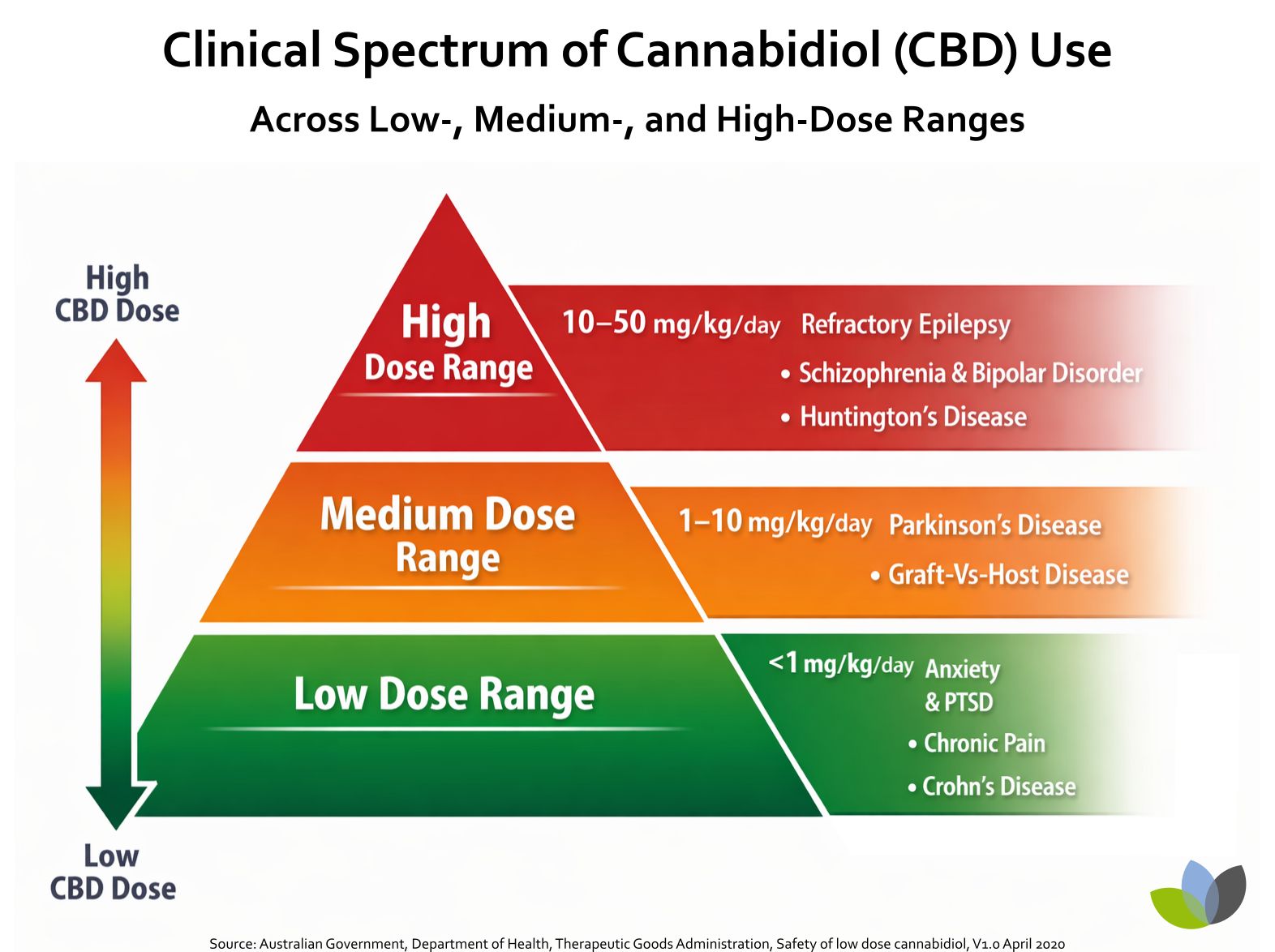
Clinical Spectrum of Cannabidiol encompasses the full range of dose-dependent therapeutic applications observed in current medical research. It describes how cannabidiol (CBD) acts differently across low, medium, and high dosing strategies. As dose levels increase, clinical targets shift from symptom management to disease-modifying interventions.
High-Dose Levels in Clinical Spectrum
At the high-dose level as given in the report by the Australian Government [1], typically 10–20 mg/kg/day and occasionally up to 50 mg/kg/day [2], clinicians primarily target refractory epilepsy. In these cases, patients often show meaningful seizure reduction. Therefore, this range holds the strongest evidence base within the Clinical Spectrum of Cannabidiol. However, when physicians apply similar doses to schizophrenia, bipolar disorder, or Huntington’s disease, outcomes vary. While some trials report symptom improvement, others show limited benefit. Thus, psychiatric applications remain investigational [3, 4, 5].
Medium-Dose Levels of Cannabidiol
In contrast, the medium-dose range of 1–10 mg/kg/day addresses conditions such as Parkinson’s disease and graft-versus-host disease. Researchers have also tested a range between 1.25 and 7 mg/kg/day [5] in both controlled trials and case studies. Although some studies report improvements in non-motor symptoms of Parkinson’s disease, results remain preliminary. Consequently, larger controlled trials must confirm long-term efficacy. Comparably, a dose level of 5 mg/kg/day has been used in graft-vs-host disease [2].
Low-Dose Levels at 1 mg/kg/day
At the low-dose level, defined as 1 mg/kg/day or less, the Clinical Spectrum of Cannabidiol includes anxiety, post-traumatic stress disorder–related insomnia, and chronic pain syndromes. Clinicians frequently use fixed daily doses such as 25 to 40 mg/day for post traumatic stress disorder in a child of 10 years of age [6]. In adults a range of 25 mg/day (mainly) up to 75 mg/day [7] was studied for this disease.
Nevertheless, therapeutic effects often appear modest. For example, a randomized controlled trial in Crohn’s disease showed safety but no significant efficacy at 10 mg per day.
Importantly, this structured gradient highlights a concentration-dependent pattern. Higher doses produce measurable neurologic effects. Meanwhile, lower doses tend to support symptom-oriented care. As research expands, investigators will refine dose optimization strategies. Ultimately, the Clinical Spectrum of Cannabidiol will depend on indication-specific protocols, pharmacokinetic precision, and rigorous clinical validation.
Measures by EFSA on CBD uptake
In its 2026 update, EFSA [8] refined its risk assessment and proposed a provisional safe intake level for adults of 0.0275 mg per kilogram of body weight per day. We reported recently. Thus, a 70 kg adult would reach a provisional limit of roughly 2 mg per day. However, EFSA limited this value to highly purified CBD isolates that meet strict specifications.
References
[1] Australian Government, Department of Health, Therapeutic Goods Administration, “Safety of low dose cannabidiol”, V1.0 April 2020, link.
[2] Millar, S.A., Stone, N.L., Bellman, Z.D., Yates, A.S., England, T.J. and O’Sullivan, S.E., 2019. A systematic review of cannabidiol dosing in clinical populations. British journal of clinical pharmacology, 85(9), pp.1888-1900.
[3] Mannucci, C et al, 2017. Neurological Aspects of Medical Use of Cannabidiol. CNS Neurol Disord Drug Targets. 2017: 16(5):541-553.
[4] McGuire, P et al, 2018. Cannabidiol (CBD) as an Adjunctive Therapy in Schizophrenia: A Multicenter Randomized Controlled Trial. Am J Psychiatry 175:3, p225-231.
[5] Khoury, J.M et al, 2016. Is there a role for cannabidiol in psychiatry? The World Journal of Biological Psychiatry Vol 20:2, p101-116.
[6] Shannon, S. and Opila-Lehman, J., 2016. Effectiveness of cannabidiol oil for pediatric anxiety and insomnia as part of posttraumatic stress disorder: a case report. The Permanente Journal, 20(4).
[7] Shannon, S., Lewis, N., Lee, H. and Hughes, S., 2019. Cannabidiol in anxiety and sleep: a large case series. The Permanente Journal, 23.
[8] EFSA Journal 2026;24(3):9862 doi: 10.2903/j.efsa.2026.9862
Expert’s opinion
From a clinical pharmacology perspective, the Clinical Spectrum of Cannabidiol demonstrates a clear dose–response gradient. High doses show validated efficacy in refractory epilepsy, whereas lower doses target symptom modulation with inconsistent outcomes. Therefore, clinicians should prioritize indication-specific dosing strategies and evidence-based protocols rather than extrapolating benefits across therapeutic categories.

