
CBD Release Profile: Granule vs. Oil
Overview
The CBD release profile: granule vs. oil shows clear differences in solubility, absorption, and user experience. CBD and THC dissolve poorly in water, so the surrounding matrix strongly shapes their release. As a result, formulation choice directly affects performance.
Solubility and Release Behavior
CBD and THC dissolve well in lipids. They dissolve very poorly in water. This contrast drives the release behavior of each format. Oil supports solubility but slows release in the digestive system. Granules disperse faster and allow more controlled release.
Why Oil Is Common
Producers often choose oil because it dissolves cannabinoids easily. It also stabilizes CBD [1] and THC. Oil formats require simple equipment and low processing effort. This makes them accessible for many manufacturers. Consumers also recognize oil tinctures, which helps initial acceptance.
Limitations of Oil Formats
Oil creates a heavy mouthfeel. Users might dislike the taste. The texture often lingers after intake. Sublingual use feels uncomfortable for some people. Oral intake without water feels unnatural and reduces compliance.
Oil also limits product design. It does not blend well with drinks or dry mixes. It restricts innovation and reduces dosing accuracy. Release and absorption vary strongly with food intake. First‑pass metabolism lowers the effective dose. Storage issues may appear due to oxidation or phase changes.
Advantages of Granules
Granulation offers a modern alternative. Generally, granulated particles disperse more quickly in water. They support faster dissolution and more predictable release. Through formulation design, they also allow adjusting controlled release properties, which helps optimizing the CBD release profile in each application.
Granules enhance consumer experience by avoiding oily taste. They fit well into capsules, tablets, sachets, and functional foods. Mouthfeel is better, doors are open for precise dosing and stable packaging. So, speaking about acceptance levels, granules might be superior to oil-based formulations in several aspects!
CBD Release Profile: Granule vs. Oil
Granules can reduce variability caused by food intake. They support controlled‑release formulation designs, e.g. in food, medical or pharmaceutical applications. Oil releases CBD slowly and potentially inconsistently. Its performance depends heavily on the digestive state.
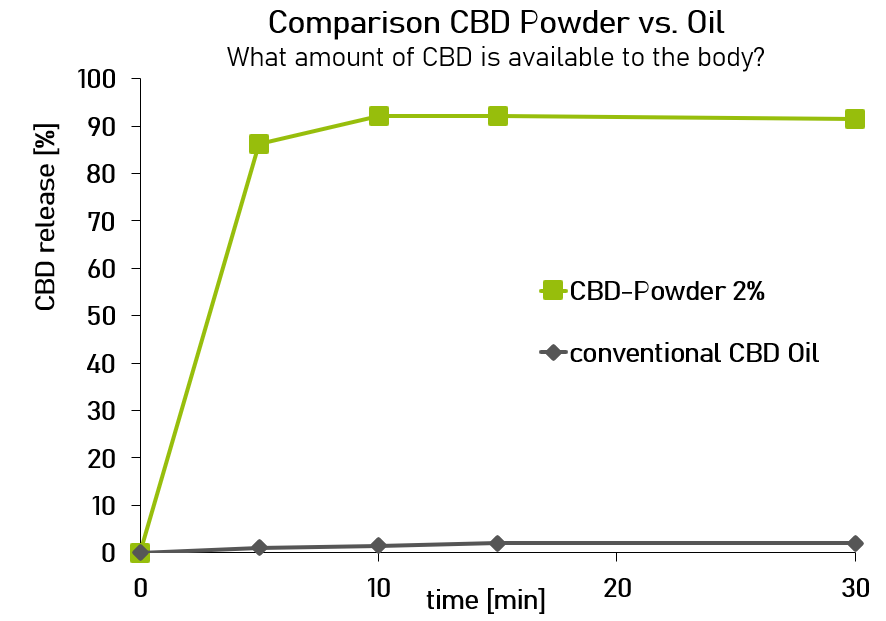
Comparison CBD Powder vs. Oil: time dependent release profile. After 10 minutes, CBD Powder releases more than 90%, while CBD is released less than 5% from the oil.
Conclusion
The comparion of the CBD release profiles of an granule and oil formulation highlights clear advantages for granules. Oil remains simple and familiar. However, granules deliver better release behavior, improved solubility performance, and higher consumer acceptance. They support modern product formats and more reliable outcomes.
References
[1] P. Jelínek et al., J Cannabis Res. 2025 (8)5. doi: 10.1186/s42238-025-00371-y
Expert’s opinion
CBD granules deliver a cleaner, faster, and more predictable release than oils. Their water dispersion improves absorption and avoids the heavy mouthfeel of oil formats. As a result, granules offer better consumer acceptance, more stable dosing, and greater flexibility for modern product design.

